|
Dear Colleague:
Several years ago, Silicon Valley pundits
predicted that value-added IP-based services would soon
enable internet and media giants like Microsoft, Yahoo,
Disney, Viacom, Google to capture the lion’s
share of telecom industry revenues.
Telecoms -- so the story goes – were “dumb pipe
providers” and didn’t have the knowledge or clout to
succeed with value-added services. They would have
no choice but to lease their pipes at bargain-basement
prices and see the value of their network investments
dramatically decline.
So far, the dumb pipe theory hasn’t proven true.
In recent years
many telecoms have grown handsomely while the internet
and media giants have made only limited penetration. In
emerging countries like Russia, China, and India, telecoms
are among the fastest growing companies in their countries.
Perhaps the greatest dumb pipe success story of all is
Carlos
Slim, the man who controls Mexico’s Telmex and América
Móvil, and whose telecom investments are now worth $60
billion, making him the second richest man in the world --
surpassing even Bill Gates.
But how, you ask, could this happen? How could the dumb
pipe providers succeed while the technologically savvy
internet and media titans faltered?
I’ll tell you. Carlos Slim and the other telecom tycoons
knew something that their opponents didn’t. To extract
value from network investments, you don’t need a lot
of cutting-edge IP-services, location based services, or
advertising-enabled handsets.
You basically need to be expert in one value-added
service that’s worth all the rest. . . Billing.
Billing not only assures service revenue, it’s the
enabler of conversations with the customer.
In today’s telecom market, billing expertise usually spells
the difference between telecom operators who are gaining
market share and those falling behind. And it encompasses
a wide range of systems from pre-paid IN charging and
real-time convergent charging. . . to postpaid billing and
billing for interconnect and content partners.
While the revenue assurance role of billing is critical,
in recent years, it’s the merchandising and marketing role
of billing that’s delivering the greatest value. In the
wireless market, for example, billing software is
increasingly enabling services such as real-time advise of
charge, lifestyle packages, content charging, and marketing
promotions.
But what billing capabilities are vital to your company’s
future growth? And which billing vendors should your company
rely on to provide that all-important marketing and
accounting dialogue with customers?
To get answers to those questions is the purpose of
TRI’s report, The
Telecom Billing and Charging Market. This 289-page
report pinpoints what billing capabilities look most
fruitful and which vendor players are making a difference.
The study is really two reports in one: a thorough qualitative analysis of billing market
trends combined with an informed quantitative
estimate of market size, vendor revenue breakouts, market
share, and forecasts delivered in software you can
manipulate as you choose to create charts, tables, and Excel
reports.
In addition to its detailed, 8- to 13-page analyses of
major billing companies, the report tackles several of the
billing market’s most pressing issues, including:
- Wireless Merchandising and
Marketing. The wireless market is witnessing
a bewildering array of new services and marketing
initiatives that are enabled by the billing system. The
Report profiles which billers lead in this important
category and discusses the impact of new initiatives
such as life style and enterprise marketing.
- Unified Billing & Product
Catalogs. Consolidating product information
in a single repository is a boon to large carriers who
want to reuse their billing assets and promotions across
regions, business units, and technologies. Here, the
Study examines state-of-the-art and shows what benefits
unified catalogs will bring and the challenges catalogs
pose to vendors and carriers.
- Network Equipment Providers
vs. Software Billers. In the wireless market,
software vendors selling real-time billing solutions
captured an early lead in on-line convergent software.
However, the study shows how vendors such as Huawei and
Nokia Siemens Networks aim to reverse the tables on
their competitors.
- Specialty Markets.
Which markets offer the greatest potential for growth?
Large incumbent carriers, emerging carriers,
multi-operator carriers, or MVNOs? The Report show in
which markets billing vendors are succeeding and the clever
solutions they offer to give them an edge in niche
markets.
- The Rising Importance of
Interconnect Billing. The global expansion of
telecom has been a boon to interconnect traffic. Now,
carriers are investing in interconnect billing and
full-blown “interconnect management systems” that
monitor contracts, track fast-moving prices, and do
settlements. Here the Report provides details on the
innovative Telarix interconnect and Amdocs content
partner management systems.
- Product Software vs. Custom
Services. The dark black lines that separate
software and services have grayed. On the one hand are
product companies like Oracle who offer a rich suite of
pre-integrated apps integrated by the likes of
Accenture, Tech Mahindra, and Capgemini. Conversely,
companies like Amdocs and Comarch are succeeding by
self-integrating their solutions. Which strategy will
win long term – or can both safely approaches peacefully
coexist? The Report tackles this and related
issues.
TRI’s study not only sorts through the key billing
trends and over 20 billing players, the intelligence can
also help you avoid making bad decisions: investing in the
wrong kind of billing solution, for example -- or if you’re
a vendor -- entering a market segment that’s either too
competitive or too specialized to attract sufficient
customers.
The Report will help you discover:
• What are the most important market priorities?
• Which operator
success strategies can you adopt at your
own telecom organization?
• Which vendors have industry
market share and are leading
in specific niches?
• Which Billing/Charging players should be your
partners?
• What Billing industry trends can your company capitalize on?
Please scan the table of contents below. You'll see why
this report delivers the tactical and strategic information
you need to understand where the telecom billing market is
headed.
To access this market intelligence today, contact Dan
Baker at TRI's offices at 570-620-2320.
Sincerely,

Dan Baker
Research Director, TRI
The
Telecom Billing & Charging Market
Table
of Contents
A. Executive Summary (2 pages)
B. Industry Trends Perspective (2 pages)
Stocking the Data Services Candy Store
The Convergence of Postpaid and Prepaid
Network Technology Uncertainty & Retooling
The Rise of Virtual Network Operators.
C. Billing's Functions (2 pages)
Pricing Management, Customer Balance Management,
Interconnect Settlements & Partner Management, Service
Authorization, Rating, Discounting and Promotions, Billing
Cycle Management, Financial Management, Payments and
Collections, Revenue Assurance, Direct Marketing &
Merchandising
D. Billing Market Drivers (2 pages)
System Consolidation After Merger
Legacy Billing Consolidation
Fixed Mobile Convergence
Subscriber Controls over Costs and Content Access
Dual-Use Mobile Handsets
Real-Time Market Share Threats in Mobile
Lower Cost of Ownership
Competing on Better Capability Rather than Lower Prices
E. Real-time and Convergent Charging (5 pages)
Traditional IN-based Pre-Paid Platforms
Why IN-Prepaid is Still Strong in Emerging Markets: Nokia
Siemens
The Challenge of Migrating Pre-Paid to Convergence Charging
Why True Real-Time Capability is Vital
OnBoard vs. OffBoard Revenue Management: Convergys
Where Real-time Charging May Be Better than Recurring
Charges
Mixing Postpaid Wireless and Realtime Capabilities
The “Advanced Pay” Innovation of InfoDirections
Postpaid Collections in Wireless
F. The Merchandising & Direct Marketing Role of
Billing (5 pages)
Billing as Merchandising, not just Accounting System
Friends & Family Promotions and Balance Top Ups: Redknee
How Comverse Boosts the Revenue of its Clients
Amazon-Style: Thinking Like a Retailer
Offering Real-time Buying Opportunities
The Role of Subscriber Profile in Contextual Marketing
Customer Life Cycle Management
G. Lifestyle & Marketing Packages (4 pages)
Lifestyle Marketing at VimpelCom
Innovative Marketing Packages for Vodafone CZ: SITRONICS TS
The Complexity of a Multi-Operator Billing Solution: LHS
Managing the Complex Service Life Cycle of Subscribers
H. Monetary Systems for Emerging Markets (1 page)
The Special Monetary Needs of Emerging Carriers
Mom and Pop Retailers in Eastern Europe: Kabira
The Success of Voucher-less Top Ups in South America: Orga
Systems
I. Interconnect Billing Systems (7 pages)
The Interconnect Driver: Telecom Deregulation
International Voice Call Terminations
How Interconnect Deals Evolve to Become More Complex to
Manage: Intec
Telarix: Developing an Interconnect “Trading Platform”
The Interconnect Trading and Billing Platform
Revenue & Margin Assurance Virtues of Real-time Interconnect
Data
The Complexity of a Multi-Operator Billing Solution
Interconnect Crisis: Growth, Converged Networks & Compressed
Margins
Architecture of an Interconnect Billing System
J. Content Services Partner Management (2 pages)
The Rise of Content Services
The Evolution in Types of Digital Commerce
A Profile of Amdocs’ Digital Commerce & Billing Solution:
QPass
The Sales, Hosting and Billing of Digital Content
Content Delivery Options
K. The Unified Billing Platform & Product Catalog
(4 pages)
Billing and Rapidly Growing Product Line Crisis
The Enterprise Product Catalog for Large Carriers
The Billing Product Catalog at T-Mobile
The Architecture of the Amdocs Product Catalog
What the Future May Hold for Product Catalogs
The Attraction of Unified Billing Systems
The Risk that Product Catalogs and Unified Billing Brings to
Software
L. The MVNO Billing Opportunity (2 pages)
Capitalizing on Individual Customer Hot Buttons: the MVNO
Why MVNOs are Ramping up in Europe: The Auchan Group &
Comarch
MVNOs: A Mixture of Success and Failure in the U.S. Market
Wholesale Carrier Attitudes towards MVNOs
Will we see Business and Corporate MVNOs?
M. Software, Services & B/OSS Integration (5
pages)
Custom vs. Product Debates
Software and Integration Services Under One Roof: The Amdocs
Approach
Oracle’s Gambit: Enterprise Applications in Communications
Billing & Customer Care Expertise Leads to Consulting at
Convergys
Nokia Siemens Networks Touts OSS Integration with Billing
N. Billing Consolidation at AT&T Long Distance (5
pages)
Billing Systems Integration Problems
Reconciling Different Billing Software Development Cycles
AT&T Billing Systems Landscape
Consolidation via the “Concept of One”
Concept of Zero
Sarbanes-Oxley
The Database of Record
The Common Customer Identifier System
Leveraging a Service Oriented Architecture (SOA)
O. Mergers & Acquisitions (2 page)
P. Market Opportunities & Threats (5 pages)
1. Wireless Lifestyle
2. Triple Play and Wireline VoIP Markets
3. Emerging Markets Where Billing will Prosper
4. The Large Carrier Market
5. The Market for MVNO Billing
6. Risks that Product Catalogs and Unified Billing Bring
7. Semantic Integration Middleware
Q. Carrier Recommendations (4 pages)
Selecting a Billing/Charging System
Billing Convergence
Network Evolution
Enterprises and Cellular Costs
R. Vendor Recommendations (2 pages)
The Virtues of System Modularity
Porting to Low Cost Hardware
Billing Portals and Customer Support Chat
Tap into Interactive Marketing Expertise from Outside
Telecom
Value Driven Policies in Billing
S. Market Segmentation & Forecasts (8 pages)
How TRI Develops its Market Segmentations
Market Growth Forecast
OEM vs. Service Provider
Distribution Channels
Geographic Region
Service Provider Type
Service Provider Size
Delivery Method
Billing Applications
T. Billing Definitions (5 pages)
U. Case Studies (20 pages)
1. BT Global Services Billing Consolidation
2. Turkcell Affinity Marketing & Billing Innovations
3. Hybrid Charging/Billing Platform at Telkomsel in
Indonesia
4. Vodafone Australia Convergent Prepaid/Postpaid Charging
for Data Services
5. Boost Mobile, Prepaid Branded Billing at Sprint Nextel
Market
Segments & Forecasts
TRI has also sized and forecasted the worldwide
market for the billing software market in this
report. Our forecast model is based on several
parameters: TRI's historical tracking of the OSS/BSS
market; TRI’s forecast of Next Generation Network
(NGN) services growth; discussions with carrier experts; and
interviews with software and consulting vendors.
TRI's principal B/OSS analyst, Dan Baker, has been
tracking hte
The report provides 2007 base revenue and 2008 to 2012
forecasts for the global market in the following segments:
Overall Market Revenues
- Corporate, Telecom Industry & OSS/BSS Revenues
Business type
- OEM software, Telecoms software, Consulting/SI services
Channels of Distribution
- Direct, Indirect
Service Provider Type
- Circuit wireline, Broadband, Wireless, Cable/DBS, Virtual
Network Operator/Non-Facilities Operator, Other
Size of Carrier
- Tier 1 (>$10 bill. revenue), Tier 2 ($250 mill. to
$10 bill.), Tier 3 (<$250 million)
Geographic Region
- North America, EMEA, Asia Pacific, Latin America
Software Delivery Method
- Software License, Prof. Services, Service
bureau/Hosted
OSS/BSS Application Revenues of Billing Vendors
Billing Applications
- Billing, off-line/batch, Interconnect billing,
IN-based Prepaid, Charging, on-line/realtime, Mediation
Vendor
Profiles & SWOT Analysis
TRI's vendor profiles section delivers a detailed
analytical
snapshot of the leading billing companies. Twenty-two of the leading software vendors and network equipment
providers are profiled in the report as follows:
Each of the profiles are between 8 and 13 pages in
length (except for the Cellution profile which is 4-pages)
and are presented in the following sections:
1. Company Specifications and Web Links
This upfront backgrounder information in each profile is
organized in the same format for easy cross-reference in
other profiles.
Here you'll find basic company data organized for
fast retrieval and web access such as:
- Corporate backgrounder
- Overall OSS/BSS business
- Significant investors and stock market reference for
public firms
- Significant customers
- Major vendor partnerships
- Major worldwide locations
- Summaries of key products in the billing market
-
Number of employees
2. Company Revenue Breakdowns
In this section, we provide an estimate of each company's
individual revenue breakdown in the billing market.
The numbers are gathered from public documents, conversations
with people at the companies themselves, and TRI's
experience tracking the billing market since 1994.
Many companies provided guidance on their own numbers.
Here are the segments we breakdown for each company:
- Overall Market Revenues
- Corporate, Telecom Industry & OSS/BSS Revenues
- Business type
- OEM software, Telecoms software, Consulting/SI services
- Channels of Distribution
- Direct, Indirect
- Service Provider Type
- Circuit wireline, Broadband, Wireless, Cable/DBS, Virtual
Network Operator/Non-Facilities Operator, Other
- Size of Carrier
- Tier 1 (>$10 bill. revenue), Tier 2 ($250 mill. to
$10 bill.), Tier 3 (<$250 million)
- Geographic Region
- North America, EMEA, Asia Pacific, Latin America
- Software Delivery Method
- Software License, Prof. Services, Service
bureau/Hosted
- Billing Applications
- Billing, off-line/batch, Interconnect billing,
IN-prepaid and Charging, and Mediation
This calendar year 2007 data is made further accessible
in a a database
program (delivered as free software with the text report)
that allows you to create instant tables and graphs,
compare various company market shares across these segments,
and produce a variety of reports in Excel format.
Prior year (2006 and 2005) data is also provided on billing
and other OSS/BSS market for historical analysis.
3. TRI Discussion of Company and SWOT Analysis
You'll no doubt find this section the most valuable
because it's here where each company's billing business is
put into context. In this section, TRI
gets into a
free wheeling discussion on company success
stories, challenges, and significant product developments.
In this discussion, we meander quite a bit on the significance of
company histories, new product/marketing initiatives,
telecom customers, geographic markets, and competitive
forces.
The section concludes with a company Strengths,
Weaknesses, Opportunities, and Threats (SWOT) analysis -- a
candid TRI opinion on where each vendor stands
against its competitors and the suitability of its products
and services for the billing market.
TRI's competitive analysis draws from significant
research such as attending billing conferences and speaking with
billing experts at telecoms. We also held 30-minute or
longer conversations with executives at 21 of the 22 billing
companies we profiled for this report.
Getting so many billing vendors to participate was an
invaluable aid to the research effort because TRI got
to hear how each company interpreted its role in the
marketplace. In turn, TRI could challenge each
company on competitive issues, evaluate trends, and gain
insights on the company's strategy.
When TRI finished its profiles, it also gave each
company a chance to check the profile for accuracy and
comment on TRI's analysis.
In all, we think our research methodology meets the twin
goals of: maximizing competitive insights; and
maintaining a relationship of trust with the sources of this
valuable information.
* * * * *
About
TRI’s
B/OSS Market Research Reports
TRI’s B/OSS market research studies are designed to help telecoms and OSS/BSS vendors track
market innovation in the sector.
Each of our reports delivers a fully
organized body of knowledge and analysis across three
interfaces:
- Complete Microsoft
Word text of Report and Vendor Profiles.
Forecasts are delivered in MS Excel;
- A Compiled HTML file
for your desktop PC that allows searching the text and
visuals of our analysis modules, case studies, and
vendor profiles; and,
- A Software Application
(written in Microsoft Visual Foxpro) with market
segmentation and forecast data that you use to view
customized data tables, graphs, vendor comparisons, and
print documents. Note: all data and forecast
tables are also provided in Microsoft Excel and
comma delimited files can be created too.
Below are some sample screens:
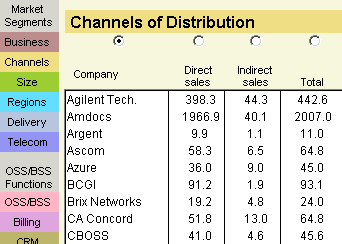
Compare
vendor market strength in grids. . .
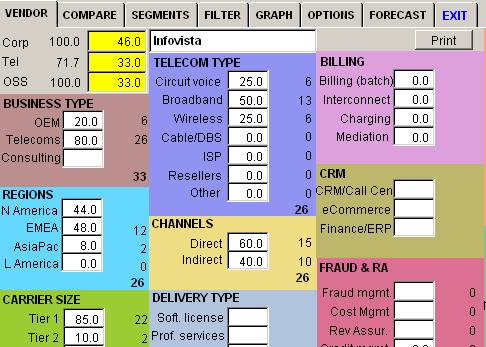
View,
modify, and print our estimates of company financials. . .
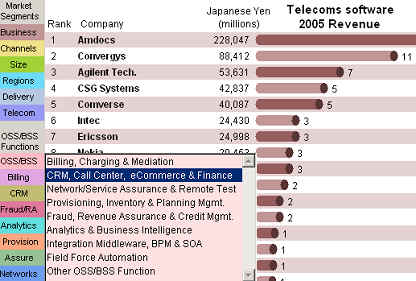
View
market share graphs in international currencies. . .
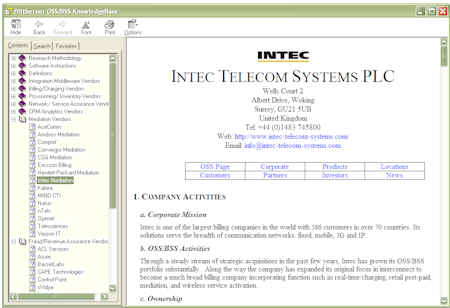
Report and Vendor
profiles delivered in a compiled HTML report. . .
Technology Research Institute
4-25 Rocky Mountain Drive North
Effort of the Poconos, PA 18330
Tel: 570-620-2320
|